
Backend Development in 2026
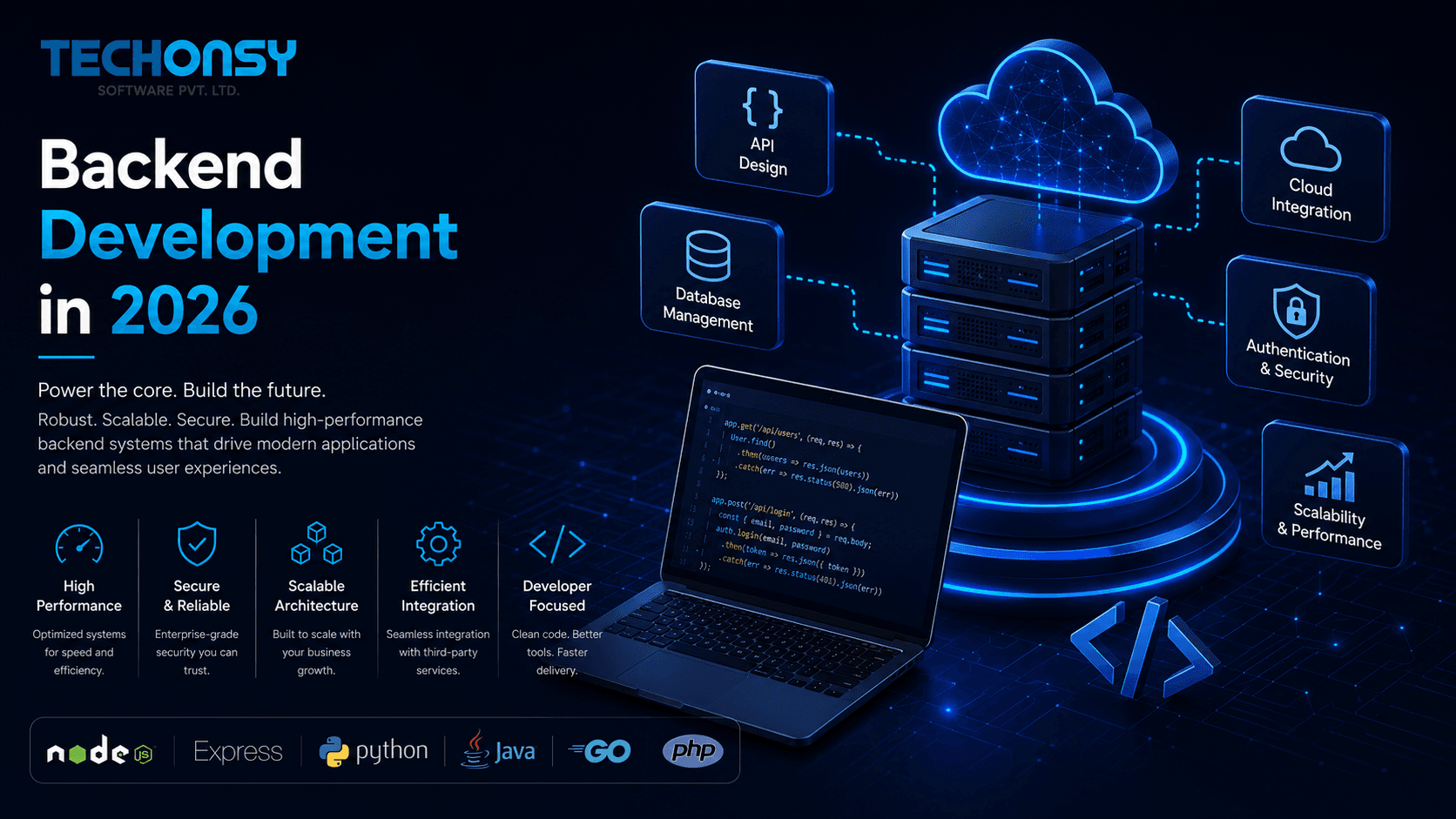
Frontend gets the attention because users can see it. Backend gets the blame when something breaks. That asymmetry has always shaped how backend work gets talked about — quietly, mostly in postmortems — even though it's usually where the hardest and most consequential engineering decisions actually live. A backend that's well built is invisible. A backend that isn't becomes the subject of every incident channel message for months.
Here's a grounded look at what backend development actually looks like today, and what separates the systems that hold up from the ones that don't.
APIs: REST Is Still Default, But Not Automatic
REST remains the default choice for most public and internal APIs, largely because of its simplicity and universal tooling support. But it's no longer the unquestioned default it once was:
GraphQL has found a durable niche where clients need flexible, precisely shaped data — particularly mobile apps and complex frontends with varied data needs across screens.
gRPC has become the standard for internal service-to-service communication where performance and strict typing matter more than human readability.
REST still wins for public-facing APIs where broad compatibility, caching, and simplicity for third-party consumers matter most.
The mistake isn't picking any one of these — it's picking one by default without considering who's actually consuming the API and how.
The Monolith-vs-Microservices Debate Has Gotten More Honest
A few years ago, microservices were treated as the obvious evolution every serious backend should aim for. That consensus has cracked, and for good reason — plenty of teams adopted microservices before they had the organizational scale or operational maturity to run them well, and paid for it in complexity.
The more honest framing now: a well-structured monolith is often the right starting point, and sometimes the right permanent answer, for teams below a certain size. Microservices earn their complexity when there's a real organizational need to scale teams independently, not services — the technical benefits alone rarely justify the operational cost.
Async Processing Has Become a Default Expectation
Any backend operation that's slow, unreliable, or non-critical to the immediate response — sending emails, processing images, generating reports — increasingly gets pushed into background jobs and message queues (using tools like RabbitMQ, SQS, or Kafka) rather than handled synchronously in the request path.
This shift matters for a simple reason: it decouples user-facing latency from the slowest part of the system, and makes failures in one part of a pipeline much easier to retry and recover from without taking down the whole request.
Authentication and Authorization Keep Getting More Nuanced
Basic authentication is a solved problem — most teams shouldn't be writing their own from scratch anymore, given how mature tools like Auth0, Clerk, and open standards like OAuth2 and OpenID Connect have become. The harder, still-evolving problem is authorization: modeling exactly who can do what, especially in systems with complex permission structures, multi-tenancy, or role hierarchies.
Fine-grained authorization frameworks and policy engines (like OPA) have matured specifically to handle this complexity, replacing the tangle of scattered if-statements that used to define permission logic in most codebases.
Rate Limiting and Idempotency Aren't Optional Anymore
As APIs face more automated traffic — bots, retries, and increasingly AI agents calling them directly — two practices that used to be considered "advanced" are now baseline expectations:
Rate limiting protects backend systems from being overwhelmed, whether by malicious traffic or well-meaning but poorly built clients.
Idempotency ensures that a retried request (which happens constantly in distributed systems) doesn't accidentally duplicate an action, like charging a customer twice.
Both used to be things teams added after an incident. Increasingly, they're built in from the start.
Observability Is Part of the Backend, Not an Add-On
A backend without structured logging, tracing, and metrics isn't fully built — it's built until the first production incident, at which point the gaps become painfully obvious. Modern backend development treats observability (via tools like OpenTelemetry) as part of the initial implementation, not something bolted on after things go wrong
What This Means for Teams Building Backends
Default to a well-structured monolith unless there's a clear organizational reason for microservices.
Match your API style to who's actually consuming it, rather than picking one by habit.
Push slow or non-critical work into background jobs early — retrofitting this later is painful.
Build rate limiting, idempotency, and observability in from the start, not after the first incident that demands them.
The Bottom Line
Good backend development in 2026 isn't about chasing the most sophisticated architecture available. It's about making deliberate, honest tradeoffs — choosing boring, well-understood patterns where they're sufficient, and reaching for more complexity only when the problem genuinely demands it. The best backends are the ones nobody has to think about, because they were built to handle the ordinary chaos of production from day one