
Full Stack Frameworks and Stacks in 2026
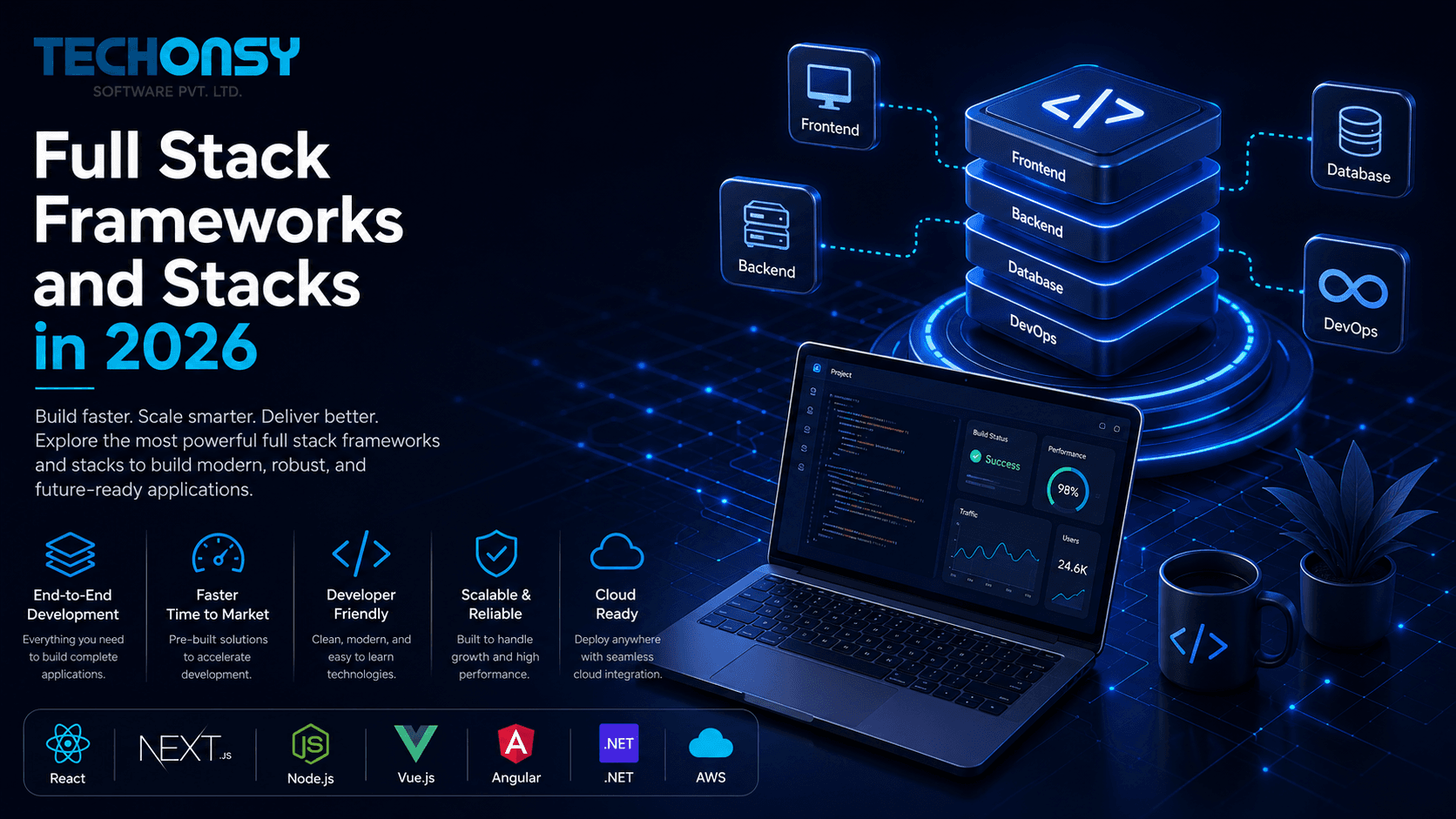
There has never been more choice in how to build a full stack application — and that abundance has quietly become its own problem. Every framework claims to be the fastest, the most scalable, the most "batteries included." Most of the differences that actually matter have little to do with benchmarks and everything to do with what your team already knows and what your product actually needs.
Here's a practical way to think about full stack frameworks and stacks today, without getting lost in the noise.
"Full Stack Framework" Means Something Different Now
A few years ago, choosing a stack meant separately picking a frontend framework, a backend framework, and a database, then wiring them together yourself. Today, frameworks like Next.js, Remix, Nuxt, and SvelteKit blur that line — server logic, routing, data fetching, and rendering all live inside one framework, often in the same files as the UI.
This shift has real tradeoffs. It reduces the glue code and decision fatigue of stitching separate systems together, but it also means the framework's opinions now shape your backend architecture, not just your UI — a much bigger commitment than choosing a frontend library used to be.
Meta-Frameworks Have Won the Frontend Conversation
React alone was never really a full solution — it needed routing, data fetching, and rendering strategy layered on top, which is exactly what meta-frameworks provide. Next.js has become the default choice for most React-based projects for this reason, with Remix offering a compelling alternative built around web standards and progressive enhancement.
Outside the React ecosystem, SvelteKit and Nuxt (for Vue) have matured into equally serious options — often praised for simpler mental models and less boilerplate, at the cost of a smaller hiring pool and ecosystem compared to React.
The Backend Decision: Framework vs. Runtime vs. Platform
Backend choice today isn't really one decision — it's three layered ones:
Runtime — Node.js remains dominant, but Bun and Deno have matured into genuinely fast, production-viable alternatives with better built-in tooling.
Framework — Express is still everywhere due to sheer ecosystem size, but newer options like Fastify, Hono, and NestJS offer better performance or structure depending on what a team values.
Platform — increasingly, "backend framework" and "deployment platform" are chosen together, since platforms like Vercel, Cloudflare Workers, and Deno Deploy impose real constraints on what backend patterns work well.
Choosing these three independently, without considering how they interact, is a common source of pain later.
Type Safety End-to-End Has Become Table Stakes
One of the more genuinely useful shifts in full stack development is the rise of end-to-end type safety — TypeScript on both frontend and backend, connected through tools like tRPC, or through framework-native patterns in Next.js and SvelteKit. Catching a mismatched API contract at compile time instead of in production has quietly eliminated a whole category of bugs that used to be routine.
Teams still shipping JavaScript without types across a full stack are increasingly the exception rather than the norm, particularly on teams above a handful of engineers.
The Database Layer Has Diversified
SQL databases (Postgres especially) remain the default sensible choice for most applications, but the surrounding tooling has changed significantly. ORMs like Prisma and Drizzle have made typesafe database access standard practice, and serverless-friendly databases (Neon, PlanetScale, Turso) have adapted traditional databases to work well with the connection patterns serverless functions require.
NoSQL options still matter for specific shapes of data — but the old instinct to reach for NoSQL by default for "modern" projects has faded as Postgres's flexibility (including JSON columns) has closed much of the gap.
How to Actually Choose a Stack
A few honest questions matter more than feature comparisons:
What does your team already know well? A familiar stack executed confidently usually beats an unfamiliar "better" one executed shakily.
What's your actual scaling need? Most products never reach the scale that justifies the complexity of a highly distributed, microservices-heavy stack.
How much do you value convention over configuration? Frameworks with strong opinions move fast early and can feel restrictive later; flexible setups are the reverse.
Where will this deploy? Some frameworks are built with a specific platform in mind, and fighting that pairing adds friction you don't need.
The Bottom Line
There's no universally "best" full stack framework in 2026 — there's a best fit for a given team, product, and timeline. The teams that choose well aren't the ones chasing the newest release; they're the ones being honest about what they actually need, and resisting the pull to over-engineer a stack for scale they may never reach.