
Generative AI in 2026
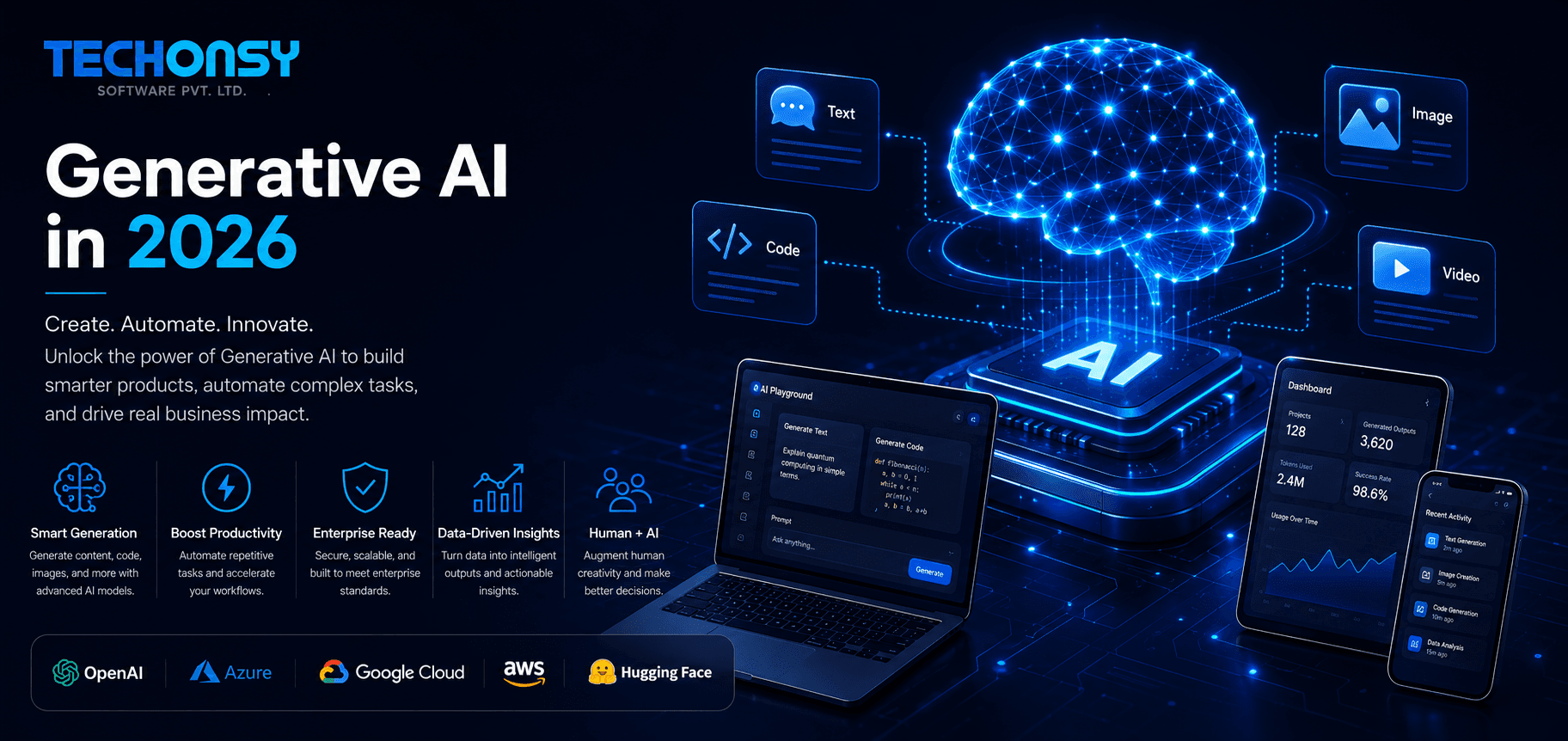
Generative AI has moved past the "impressive demo" phase. It's now embedded in products people use every day — writing assistants, coding tools, customer support, design workflows. The novelty has worn off, and what's left is a more useful question: what does it actually take to build with generative AI well, rather than just bolt a chatbot onto an existing product?
Here's a grounded look at where generative AI stands today.
The Model Isn't the Product
Early on, a lot of teams treated "we integrated a large language model" as the finished feature. That's no longer enough to differentiate anything — the underlying models are increasingly commoditized, and most serious providers offer comparable quality at the frontier.
What actually makes a generative AI feature good is everything around the model: the context it's given, the guardrails that keep it on task, the interface that makes its output usable, and the feedback loop that improves it over time. The model is an ingredient, not the dish.
Retrieval-Augmented Generation Is the Default Pattern
Fine-tuning a model on private data used to feel like the obvious path to a "custom" AI product. In practice, retrieval-augmented generation (RAG) — feeding relevant context into the prompt at query time — has become the default approach for most applications, because it's cheaper, more flexible, and easier to keep up to date than retraining a model every time the underlying data changes.
Fine-tuning still has its place, particularly for adjusting tone, format, or highly specialized tasks — but for "make this model know about our data," retrieval usually wins.
Agents Are Real, But Reliability Is the Bottleneck
AI agents — systems that can plan, call tools, and take multi-step actions on their own — have gone from research demos to genuinely useful products for coding, research, and workflow automation. But the gap between an agent that works well in a demo and one that works reliably in production is still large.
The teams building agents successfully tend to share a few habits:
Narrow scope. Agents that do one thing well outperform agents asked to do everything.
Human checkpoints on consequential actions. Letting an agent draft an email is very different from letting it send one unsupervised.
Strong evaluation, not just vibes. Teams that measure agent performance systematically catch regressions that "it seemed to work when I tried it" would miss entirely.
Prompt Engineering Has Grown Up
"Prompt engineering" used to mean finding a clever phrase that unlocked better output. That's still part of it, but the discipline has matured into something closer to real software practice: structured prompts, version control on prompt changes, systematic testing across edge cases, and clear separation between instructions, context, and user input. Teams that treat prompts like an untracked afterthought pay for it later in inconsistent, hard-to-debug behavior.
Cost and Latency Are Product Decisions, Not Just Engineering Ones
Every generative AI feature carries a real, ongoing cost per request, and a real latency cost that affects how the feature feels to use. Choosing a smaller, faster, cheaper model for a lightweight task — and reserving a larger model for the moments that truly need its extra capability — isn't a compromise. It's often the right architecture. Routing between models based on task complexity has become a standard pattern rather than an advanced optimization.
The Trust Problem Hasn't Gone Away
Generative models still make things up with total confidence, and users have gotten less forgiving of that as AI features have become more common. Products that are upfront about uncertainty, cite their sources, and give users an easy way to verify or correct output tend to earn more trust than ones that present every answer with the same unwavering confidence.
What This Means for Teams Building With It
Don't over-invest in fine-tuning before you've tried retrieval — it's usually the faster, cheaper path. Scope agents narrowly, and keep a human in the loop for anything consequential. Treat prompts as versioned, tested artifacts, not throwaway strings. Match model size to task complexity instead of using your biggest model for everything by default.
The Bottom Line
Generative AI in 2026 rewards teams that treat it like real engineering — with evaluation, cost discipline, and clear scope — rather than teams chasing the newest model release. The technology has stopped being the hard part. Building it into something reliable, trustworthy, and genuinely useful is where the real work is now.